Posted on December 12, 2019 by small20
All Power (and Paper) to the People
by Alex Griffin-Little
The 1960s were obviously a time of great political and social change in America. Many of these changes emanated from college campuses across the country, and even Purdue University got a piece of the action. One of the ways in which radical and leftist ideas were disseminated to the public was through underground newspapers. Underground newspapers were independent and obviously had more control over the content they created as opposed to more mainstream and privately-owned newspapers. As a result, the stories that underground newspapers reported on could be more taboo and politically charged. However, underground newspapers were not only radical in the nature of the content they reported on but also in who was doing the reporting. Underground newspapers began popping up around the 1960s and 1970s due to the growth in popularity of social movements and the lack of coverage of these social movements in mainstream newspapers. These underground newspapers were free from the restraints of modesty and cordiality their mainstream counterparts were subject to and could thus report on controversial and radical topics. These underground newspapers, reflecting their diverse audience, had more diverse staff writers and contributors than mainstream newspapers.
Background and history
John McMillian in “Smoking Typewriters: The Sixties Underground Press and the Rise of Alternative Media in America” discussed how underground newspapers were able to grow so quickly and explained why they were popular in the first place. He stated that one major difference between underground and mainstream reporters is that underground reporters participated in the events that they covered. Thus, underground reporters were able to bring a unique perspective and as a result were more passionate about and close to the stories they covered. These reporters didn’t pretend to be objective and instead wrote opinionated pieces that were relevant to their experiences as a student. This is in direct opposition to the “prefabricated template” mainstream journalists used to cover youth culture. [1] These templates were boring and unappealing to the growing radical left, ultimately pushing them to create the type of content they wanted to read.
Another difference laid within the inherent purpose of the newspaper. “Beginning in the mid-1960s, in cities and campuses across the country, New Leftists began creating and distributing their own radical community newssheets, with which they aimed to promote avant- garde sensibilities and inspire political tumult”.[2] As McMillian noted, these underground papers sought to do more than inform, but to promote their agenda and inspire their readers to join the revolution. McMillian also noted that “most of these publications centered around the principles concerning racism, the Vietnam War and democratic accountability.”[3] These were issues that reporters wanted to cover and readers want to consume. These were also issues mainstream newspapers did not talk about. Racism and the Vietnam War were the two greatest issues discussed in Purdue underground newspapers.
Lastly, McMillian contributed the success of underground newspapers to their ability to foster a sense of community. He states “community building played a crucial role in helping youths to break away from the complacency and resignation that prevailed in postwar America, in order to build an indigenous, highly stylized protest culture.”[4] In other words, underground publications were produced by peers who were known and lived within the community they were reporting about. This personal connection made viewers more inclined to consume content because it made them feel more informed about and involved within their community. McMillian also noted that the number of underground newspapers grew very quickly. He states, “in 1965, the New Left could claim only five such newspapers, mostly in large cities; within a few years, several hundred papers were in circulation, with a combined readership that stretched into the millions.”[5]
But what led to this quick popularity change? Donna Lloyd Ellis states that the success of underground newspapers can be attributed to three main factors. The first was the emergence of a “youth culture” which emphasized drugs and a “disenchantment with the American political system.”[6] Also, a large amount of the readers- mainly college students- had the disposable income to purchase the newspapers and the leisure time to read them.[7] It is also noteworthy that the writers, contributors, illustrators, editors, etc. were also college students who had the time to produce these underground newspapers because they did not work full time and most did not have a family.
The second factor that contributed to the success of underground newspapers was the failure of daily newspapers to cover the news young people wanted to actually read.[8] Young people were not interested in fluff pieces or pro-war propaganda. Instead, they wanted to read about the issues that would actually impact them, such as racism, sexism, and the Vietnam War. It is plausible to assume that readers were also upset with the lack of representation in those who were writing the stories, ultimately pushing them to be their own representation.
The third reason underground newspapers became popular very quickly was quite simply because of the comparatively low overhead of new journalistic technology.[9] McMillian concurs with this statement, stating, “before the 1960s, newspapers had to be set on a Linotype machine- a procedure that was both costly and difficult. But with the advent of photo offset printing… one could print several thousand copies of eight or sixteen-page tabloids for just a couple hundred dollars.”[10] This low cost of investment made it possible for college students without a ton of disposable income to front the cost of the first edition and then be able to sell the copies and breakeven or even make a profit. However, 72% of the underground papers queried by UPS claimed they made no profit.[11] The fact that most undergrounds did not seek to make a large profit is another big difference between mainstream newspapers. Papers like the Journal & Courier had one ultimate goal: to make money. Since underground newspapers were not as worried about profit, they did not need to appease advertisement companies and could instead create controversial content that their readers wanted to consume.
The low cost of production also allowed for the copies to be sold at a low rate that poor college kids could afford. Bauls sold for about 25 cents each, which was affordable enough to purchase every other week or so and was actually competitive with the price of mainstream newspapers. The New York Times cost around 15 cents per copy in 1969. With the emergence of a tangible youth culture, the ability of college students to both read and produce content because of their leisure time, the low cost to produce newspapers, and mainstream papers failing their younger audience, the underground press syndicate had nearly everything stacked in their favor.
Bauls
One of the biggest underground newspapers on Purdue’s campus in the late 1960s was Bauls. Bauls means “wild or mad” in Hindu, which is an accurate description when considering the type of material they were putting out. At least five issues were created during 1969, with the first issue being sold on January 6, 1969. Originally, the Peace Union, a student organization on campus, sold copies of Bauls inside the Union. However, the University responded to the sale of the very first edition by preventing the open sale of it on campus the day after it came out. When questions about who was producing this paper began to be asked, the president of the Peace Union, Clark Shimatsu, said the club had “no official connection with the publication” as quoted in an article written in the Journal and Courier.[12] The Peace Union and the Bauls publication team responded to this censure by selling copies in secret, which most likely had an ultimate effect of drawing attention to the newspaper and then encouraging students to buy and read it just to see what was so bawdy about it.
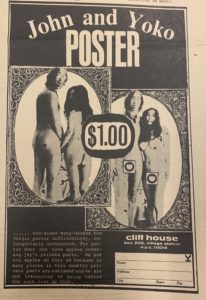
Volume I, Number II came out on February 3, 1969 and detailed the censure controversy. It also contained quite strong language about Purdue administration, stating “the administration first broke the rules, not the Peace Union and not Bauls. At this point, it was apparent that the administration could not even be relied upon to keep its own rules, but would instead violate them to prevent distribution by Bauls.”[14] The rules the writer was alluding to was the previously agreed upon sentiment between Bauls and Purdue which stated that Bauls could sell their paper out in the open if no “indecency” was visible. Bauls argued that since they kept up their end of the bargain (ensuring that no nudity was being publicly displayed), they should be allowed to continue the sell of their newspaper.
Purdue administration, however, had a different story. Two days after the banning of Bauls, The Exponent ran a story detailing the timeline of the censure, of which included a quote from the Assistant Dean of Men James H. Scott. Scott stated that the paper was banned for “specific words and the portrayal of a nude man and women” in the paper.[15] Scott went on to state that the Dean’s Office “does not consider the publication an appropriate kind of literature accepted among men or women in our academic community to express and convey ideas.”[16] There was no mention of the alleged agreement Bauls had with the administration, nor a description as to how long the paper would be banned from campus.
However, the Board of Trustees had a bit of a different take than the Dean’s Office. The January 14 Board of Trustees minutes described the content Bauls created and a brief description of the censure timeline, but then they get into the legal jurisdiction of the administration. For example, one trustee suggested that “the administration and Trustees must look closer to see what authority actually rests with them” and that there is “no legal issue is involved in sale of the underground paper; defiance of the administration is not a legal issue. The paper is not a student organization publication so there is no legal exposure.”[17] The question of legal jurisdiction over what they could do with “obscene” underground newspapers was a question that plagued both the Board of Trustees and Purdue administration for years and it was never quite answered. When asked the question of what to do immediately, one Trustee suggested that “the present posture of the Trustees and the administration should be to withhold any action until the appropriate University Senate committees have investigated and reported. Members of the faculty feel that the issue concerning the Exponent and the underground publication is the issue of freedom of the press, not the issue of violation of University regulations.”[18] In other words, the administration should hold off on permanently banning Bauls from campus until they are sure they are in the legal clear. However, this did not come out of the kindness of the Board’s heart. From the little they talked about the underground newspaper scene and student activism in general, the Board appeared to be covering all of their legal bases. They, nor the administration, were not friends of the underground newspaper.
But why was Purdue so harsh on underground newspapers and what were they really scared of? Purdue’s argument that it was all about nudity and obscenity does not really hold up when taking into account how Purdue responded even after Bauls stopped selling copies in public. Administration banned the selling of all editions of Bauls, threatened to suspend anyone caught selling the paper, and encouraged West Lafayette to pass an ordinance requiring all sellers of any paper to register with the police department. There were even instances of police officers setting up stings against Bauls editors. These actions point to a larger fear- a fear of administration losing control over the education and mobilization of their students. Purdue was already in the process of losing control of the Exponent, who began gaining independence in November 1968 when President Hovde tried to fire Editor William Smoot and Exponent staff refused to appoint a new editor. With this loss of an arguably less scandalous newspaper, Purdue administration wanted to really prevent anti-Purdue and anti-police rhetoric since they no longer had a means to reach the public via newspaper anymore. And perhaps they did have a reason to be scared, since a member of the Peace Union told the Exponent that they sold over 2,000 copies of the first edition of Bauls on the first day.[19] News travels quickly when the right stories are being written.
So what type of content did Bauls produce? Bauls was more than a typical newspaper with articles and exposes- it was a piece of artwork. It included drawings, poems, photographs, sketches and full-page artistic spreads.
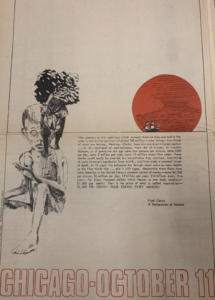
In addition to creating artistic and aesthetic spreads, Bauls also wrote about very taboo and underreported stories concerning Purdue, Indiana as a whole, and other events pertaining to The Resistance. This can be seen with Bauls coverage of the 1968 raid of the Indianapolis Black Panthers by police. Bauls reported on this event on page two of their very first edition in an article titled “Naptown Cops Attack Panthers.” The contributor opened with a description of what happened, writing “the pigs have gone too far. On Wed. Dec. 19 Federal agents and the racist police department attacked the Black Panther office in Indianapolis… The cops wrecked the office, destroying the furniture and literature. After the raid $610 of Panther funds were missing. No store of weapons were found.”[21] Now obviously this article had biased undertones (as seen with calling the cops pigs), however, it also had accurate and useful information about the raid and by reporting on it they were able to confirm that Indiana cops attacked and stole from a Black power group in a racially motivated raid. No other local mainstream newspaper reported on this event, so without Bauls, it is plausible to assume that many Purdue students wouldn’t have even known about it.
In addition to reporting on the happenings of the Revolution throughout the state and country, Bauls also wrote very specific and useful guides and advice for Purdue students. In the second issue, they released a “realistic” course guide with descriptions about each major department. For example, they described the History department as “devoted to the celebration of the status quo where racial oppression and imperialism are never presented as matters of policy, but rather as temporary aberrations in America’s march towards its glorious destiny.”[22] Bauls concludes by stating “currently, in the School of Humanities, the Department of History is a standing academic joke… History at Purdue is dusty and irrelevant. Avoid it at all costs.”[23] Bauls concluded by listing around ten History professors to “avoid at all costs” because they “rank among the University’s hardcore conservatives.”[24] Bauls had a point, since many of the History classes being taught centered around Russia and the Cold War and nearly all, if not all, were taught by white men.
-
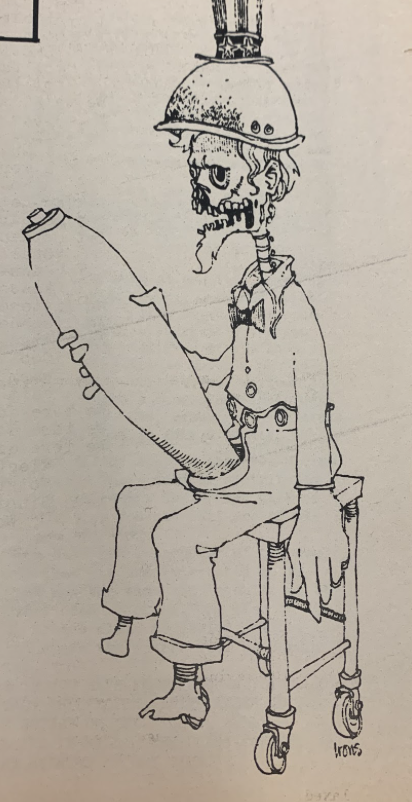
- A sketch in response to the US’s involvement in Vietnam [26]
-
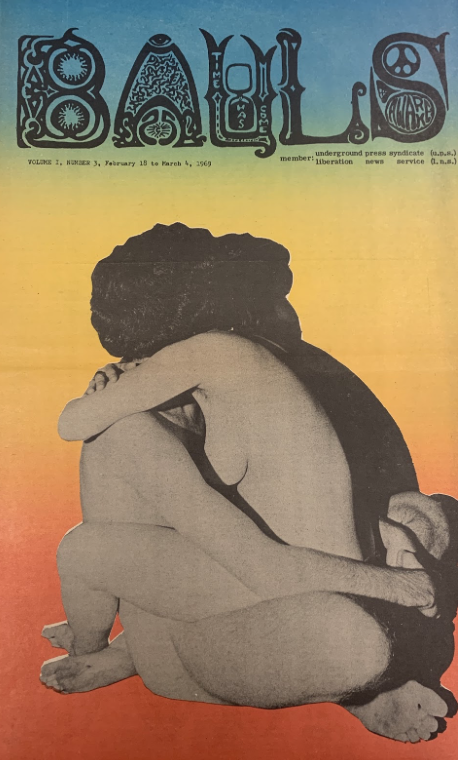
- The nude issue, in response to Purdue’s attempt to ban Bauls from campus[25]
To determine who was contributing to the underground newspapers, I flipped through a few editions of Bauls and kept an eye on who was writing each story. The first few editions of Bauls had a Staff Box in which the staff analyst was a woman, as well as a few of the legal advisors and artists being women as well. When looking at who was writing the specific articles, it was a bit more difficult since most of them were written anonymously or with a pen name. However, at least five articles written by women just within two issues of Bauls. Of these articles, none of them were specifically targeted at a female audience. Instead, women were able to write about important issues, such as riots happening at other universities and administrative changes at Purdue, such as the fee increase. These women were also not called “Women Staff Writers” and instead were seen as seen as full contributors tasked with important stories to cover.
The Tobacco Road
The Tobacco Road was a Lafayette underground newspaper that began printing in 1970. Dubbed as “Lafayette’s only underground paper,” The Tobacco Road had more of an anti-war focus but they also reported on police corruption and brutality, the mistreatment of students of color, and economic inequality.
![, An image of a group of police officers assaulting Lady Liberty and Lady Justice. This illustration was paired with Tobacco Road’s “Pig League” which were trading cards of drug busting cops [28]](https://ascblogs.lib.purdue.edu/fall2019-honors49900/wp-content/uploads/sites/3/2019/12/SOLDIER-MSP99.-5.png)
![A political cartoon in response to police brutality and patriotism [27]](https://ascblogs.lib.purdue.edu/fall2019-honors49900/wp-content/uploads/sites/3/2019/12/LIBERTY-MSP99.6.png)
The Tobacco Road also did a great interview with the editor of the Exponent, Stephanie Salter. The Tobacco Road asked Salter what the role of the Exponent was versus that of underground newspapers. She stated the role of the Exponent was to “inform, educate and entertain, not necessarily in that order.” [29] Salter was then asked if the Exponent was a “straight press” like the Journal & Courier, in which she responded “I don’t see us as a Journal & Courier. The J & C is a Neanderthal stage where a man can’t talk at all and we are where he just begins to form a few more words… I see us as the next stage, we provide a more specialized coverage of the daily news that affects students’ lives, than do other daily Hoosier newspapers.” [30] As Salter described, the Exponent was not at all like mainstream daily newspapers. If anything, it was a more polished and much less obscene version of an underground newspaper. Both were student run and independent of the University, however, the Exponent, due to their status as an established and mainstream newspaper, was more restricted in the type of content they could produce.
Contributors to The Tobacco Road were also key organizers of the May 1, 1970 ROTC strike. They described the background behind and reasoning of the protest, opening by stating, “the first blood of Purdue students ever spilled in a political demonstration was coagulating on the floor of the Armory. The campus cops had finally proved their manhood with their phallo-like batons, and for many students in the Armory, they saw the real Amerika for the first time.”[31] Immediately, one can tell that the author was not trying to remain unbiased. Instead, because of their involvement and deep knowledge of the protest, The Tobacco Road was able to write from a unique perspective of what the protest was truly like from someone who actually experienced it.
The unnamed contributor described the timeline of the protest quite quickly and simply. They stated “on that May afternoon, several hundred Purdue students who had had enough of the government’s genocidal war in Southeast Asia, nonviolently and with high spirits, demonstrated and sat-in at a military review. And it all ended with ten arrests and thirty students suspended and four students taken to the health center.”[32] By this account, the students who participated were nonviolent and were unjustly attacked by police.
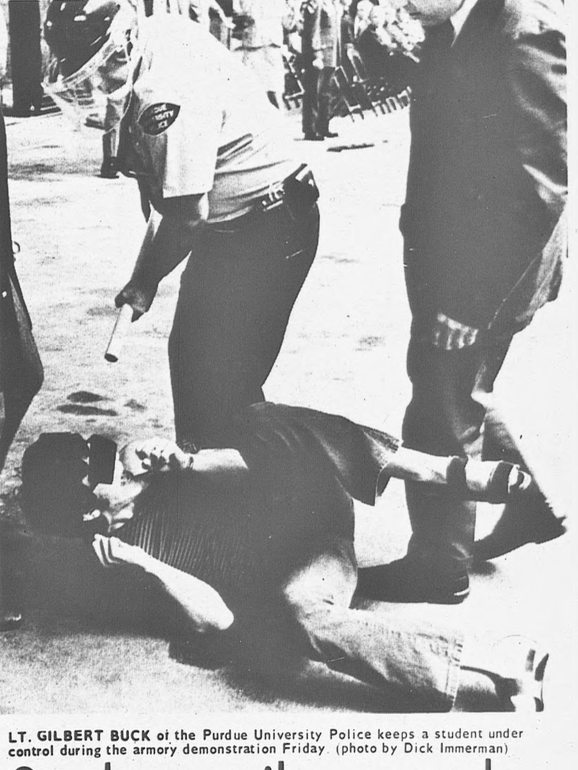
Although obviously less graphic and persuasive, the Exponent covered the protest similarly to the Tobacco Road. The Exponent included the reasoning behind why the protest occurred, as well as how the protest became violent. Staff Writer Mark Banner wrote “without warning, the ominous quiet was broken by screaming demonstrators as the police began poking and jabbing students with their riot clubs, then swinging them as the students got up to run. Three police simultaneously beat Students for a Democratic Society (SDS) leader Bob Rose, who was taken to the Health Center with two gashes in his head. Three other students were taken to the Health Center for minor injuries. No police were reported injured.”[33] The Exponent was not afraid to call out the violence at the hands of police and they included pictures that showed exactly how the police treated the protesters. However, this is not the angle the Journal and Courier took when describing the protest.
The Journal & Courier
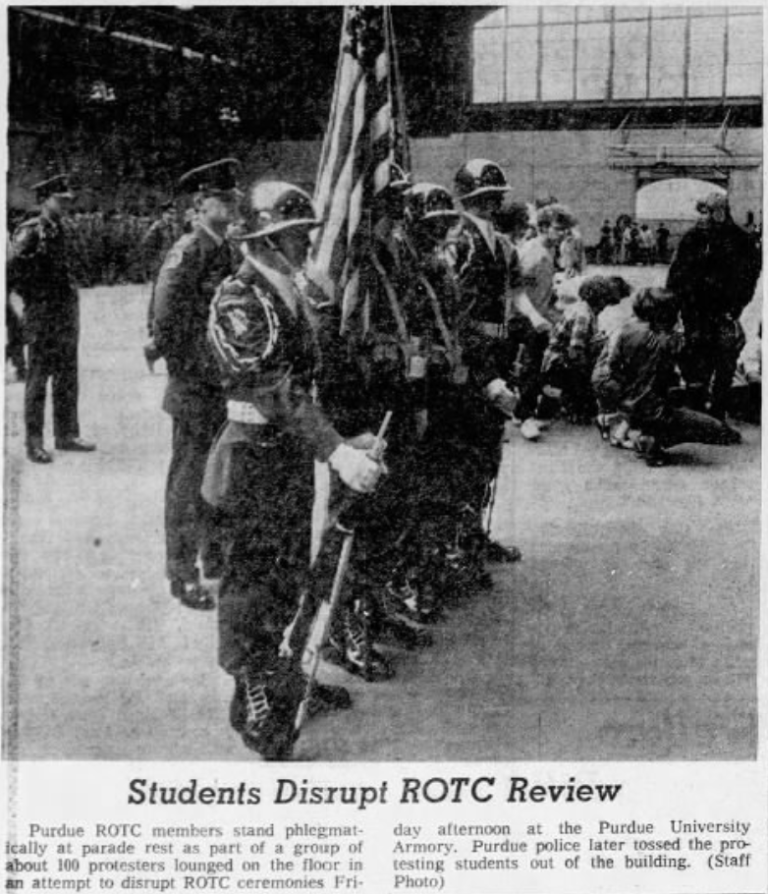
The Journal & Courier had a different take on the May 1 ROTC protest than that of the underground newspapers. The J & C reported “Door Smashed: the protesters entered the building, tearing down a large ROTC billboard and breaking an overhead door. A band of about 30 Purdue police, helmeted and carrying riot sticks, appeared at the south end of the armory in an attempt to disperse students. Rocks were thrown through armory windows by students outside the building.”[35] There was no mention of why the protests occurred beyond a surface-level mention of anti-war rhetoric. Also, neither the Tobacco Road nor the Exponent mentioned anything of rock throwing or any other violent action taken by protestors, thus resulting in conflicting stories. Also, the J & C failed to mention the number of students who were injured, nor did they mention that no police officers were injured at all. They did not include any photos of the police assaulting the protesters. Instead, the Courier implied that the protest was a disservice to ROTC and Purdue and that the protesters deserved the abuse they suffered at the hands of the police. The Courier also decontextualized the protest, failing to mention that there had been multiple non violent anti-war protests in the past and that this specific protest was in response to the escalation of the Vietnam War into Cambodia. This deliberate misconstruction of and rhetoric towards the protest explains why students were not interested in reading the Courier and why underground newspapers were needed to fill this gap.
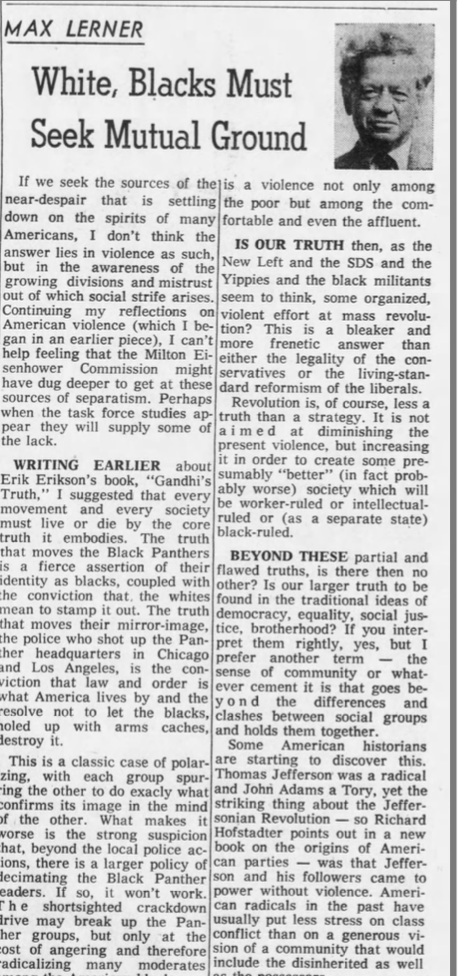
Another example of the Journal & Courier responding quite differently to events concerning the Revolution can be seen with their treatment of the 1968 raid of Indianapolis Black Panthers. The day after the raid, the newspaper ran an article written by Max Lerner, a syndicated columnist, titled “White, Blacks Must Seek Mutual Ground.” Lerner states, “the radicals of today have forgotten this sense of cement and community, and each little group is pushing its own impassioned, fragmented separatist truth, each dead-certain that its truth is absolute.”[37] The author goes on to argue that the Black Panthers’ vision of a separate and safe society for African Americans away from white society was a step in the wrong direction and instead all Americans should hold hands and focus on the American identity instead. Lerner recognizes why an organization like the Black Panthers exists, however, he argued that they were no longer necessary/ a good response to the issue of racism in America. This can be seen when he states “the crime against the blacks in the past has been to exclude them from the larger community. The answer cannot be a separatism movement.” [38] By stating that the crimes occurred in the past, he appears very dismissive of the current struggles Black Americans were facing during the late 1960s. There was no other mention of the Black Panthers in the rest of the newspaper, nor was there any mention of the raid on the Indianapolis Black Panthers in any of the following editions. Apparently, the Courier did not consider this raid worthy enough to write even one story about it.
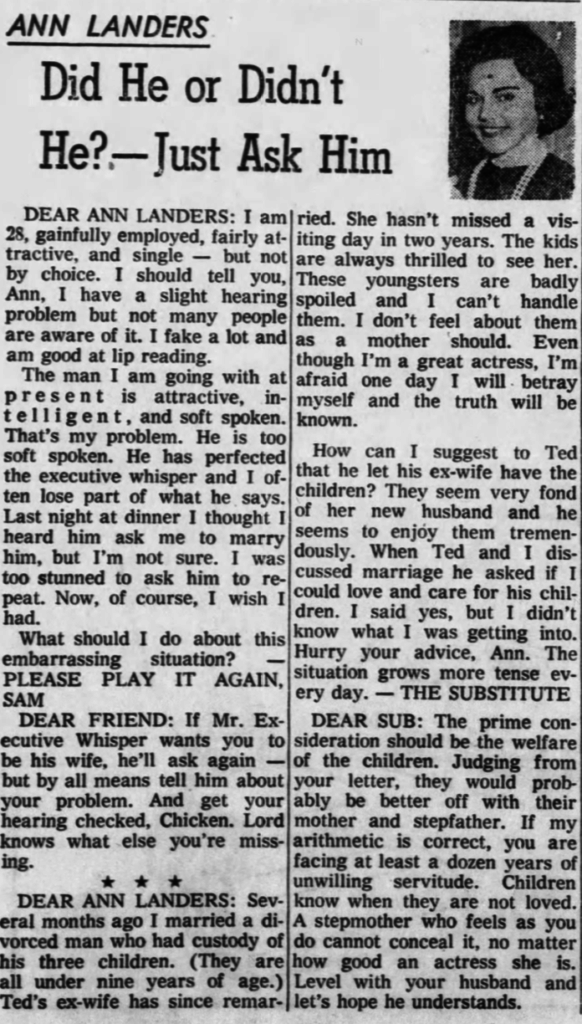
In addition to reporting on content not of interest to the youth, mainstream newspapers were also uniform in their writing staff. To determine what type of people were writing the mainstream news articles, I scrolled through the December 19, 1969 edition of the Journal and Courier. By looking at the bylines and making some educated guesses, I found three articles that were written by women. Two of these articles were “Dear Abby” advice columns in which women would write in asking for advice on love and romance (as seen with Ann Landers’ “Did he or didn’t he?- Just ask him” advice article). The only other non-advice column was an article written by Mary Kemmer titled “Holidays Bring Families Together.” Kemmer, who is the Journal and Courier’s “Women’s Staff Writer” was apparently tasked with writing what different families were doing during the holidays. If you were wondering, “Mr. and Mrs. Charles Craw spent a couple of days with friends at Fort Wayne, and while visiting attended the Christmas party for members of the staff of the Town House, a Baptist retirement home.”[40] These examples show that men were the predominant writers of mainstream news articles, and of what few women were asked to write, they were to report on issues pertaining to women and families, and apparently what random people were doing during the Holidays.
Conclusion
Underground newspapers were radical in more ways than one. Bauls and The Tobacco Road, underground newspapers at Purdue active in 1969 and 1970, were radical in the nature of their content as well as in who was producing that content. By reporting on events such as the police raid on the Indianapolis Black Panthers and the 1970 ROTC protest and by their refusal to refrain from printing controversial nude images and artwork, Bauls’ and The Tobacco Road’s radicalism was contagious and obvious. Bauls and The Tobacco Road were also radical in that a substantial number of articles and artwork were produced by women. By tasking women with writing about important events, women were able to tell their experiences and participate in the revolution alongside their brothers. More mainstream newspapers, like the Lafayette Journal and Courier, did not entrust women with valuable reporting opportunities and instead required them to write pieces specifically to be read by other women. Thus, due to the lack of adequate content and a surplus of inadequate writers, underground newspapers became extremely popular at Purdue. A newspaper cannot truly be radical unless those who contributed to its production were as diverse as the revolution they were reporting on.
[1] John McMillian, Smoking Typewriters: The Sixties Underground Press and the Rise of
Alternative Media In America (Oxford University Press, 2011), 3.
[2] McMillian, Smoking Typewriters: The Sixties Underground Press and the Rise of
Alternative Media In America, 4.
[3] McMillian, Smoking Typewriters: The Sixties Underground Press and the Rise of
Alternative Media In America, 4.
[4] McMillian, Smoking Typewriters: The Sixties Underground Press and the Rise of
Alternative Media In America, 5.
[5] McMillian, Smoking Typewriters: The Sixties Underground Press and the Rise of
Alternative Media In America, 4.
[6] Donna Lloyd Ellis, The Underground Press in America: 1955-1970 (University of
Pennsylvania, 1971), 102.
[7] Ellis, The Underground Press in America: 1955-1970, 102.
[8] Ellis, The Underground Press in America: 1955-1970, 103.
[9] Ellis, The Underground Press in America: 1955-1970, 103.
[10] Meredith Blake. “Ask an academic: the sixties underground press,” (The New Yorker,
2011).
[11] Ellis, The Underground Press in America: 1955-1970, 114.
[12] “Bauls Sellers Warned of City Soliciting Law.” Journal and Courier (Lafayette, IN), Feb, 25, 1969.
[13] Collection of Student Newspapers at Purdue University, Box 1, Purdue Archives and
Special Collections, MSP 99.
[14] Mike Brand, “The Peace Union Replies.” Bauls (West Lafayette, IN), Feb. 3, 1969.
[15] “University Officials Suspend New Underground Paper.” The Exponent (West Lafayette,
IN), Jan. 8, 1969.
[15] “University Officials Suspend New Underground Paper.” The Exponent (West Lafayette,
IN), Jan. 8, 1969.
[16] “University Officials Suspend New Underground Paper.” The Exponent, 1969.
[17] Board of Trustees minutes, 1969 Jan. 14. 1969. The Board of Trustees. Purdue Archives
and Special Collections, West Lafayette, IN.
[18] Board of Trustees minutes, 1969 Jan. 14. Purdue Archives and Special Collections, 1969.
[19] “University Officials Suspend New Underground Paper.” The Exponent, 1969.
[20] Collection of Student Newspapers at Purdue University, Box 1, Purdue Archives and
Special Collections, MSP 99.
[21] “Naptown Cops Attack Panthers,” Bauls (West Lafayette, IN), Jan. 6, 1969.
[22] “A Realistic Course Catalog.” Bauls (West Lafayette, IN), Jan. 6, 1969.
[23] “A Realistic Course Catalog.” Bauls, 1969.
[24] “A Realistic Course Catalog.” Bauls, 1969.
[25] Collection of Student Newspapers at Purdue University, Box 1, Purdue Archives and
Special Collections, MSP 99.
[26] Collection of Student Newspapers at Purdue University, Box 1, Purdue Archives and
Special Collections, MSP 99.
[27] Collection of Student Newspapers at Purdue University, Box 1, Purdue Archives and
Special Collections, MSP 99.
[28] Collection of Student Newspapers at Purdue University, Box 1, Purdue Archives and
Special Collections, MSP 99.
[29] “An Interview with the Editor of the Exponent,” The Tobacco Road ( Lafayette, IN), 1970.
[30] “An Interview with the Editor of the Exponent,” The Tobacco Road ( Lafayette, IN), 1970.
[31] “Never Again,” The Tobacco Road (Lafayette, IN), 1970.
[32] “Never Again,” The Tobacco Road (Lafayette, IN), 1970.
[33] Mark Banner, “Students clubbed during sit-in at ROTC convo,” The Exponent (West
Lafayette, IN), May 4, 1970.
[34] The Exponent (West Lafayette, IN), May 4, 1970.
[35] Charlene Gierkey, “Purdue ROTC Review Disrupted by Students,” Journal and Courier
(Lafayette, IN), May 2, 1970.
[36] Journal and Courier (Lafayette, IN), May 2, 1970.
[37] Max Lerner, “White, Blacks Must Seek Mutual Ground,” Journal and Courier (Lafayette, IN), Dec. 19, 2019
[38] Lerner, “White, Blacks Must Seek Mutual Ground.”
[39] Journal and Courier (Lafayette, IN), Dec. 19, 1969.
[40] Mary Kemmer, “Holidays Bring Families Together,” Journal and Courier (Lafayette, IN), Dec. 19, 1969.
[41] Journal and Courier (Lafayette, IN), Dec. 19, 1969.
Banner Image Reference in bold