Posted on December 12, 2019 by small20
Physical Representation
by Zoe Malavenda
When walking into Matthews, Meredith, and Shreve Halls, how often do we acknowledge the work these women did for the university? It is important to ask the question of why such research on Mary Matthews, Virginia Meredith, and Eleanor Shreve is necessary. I entered these buildings as a student would if they were simply going to their dorm or class and evaluated the physical depictions of the buildings’ namesake and how evident it is as to who the building is named after.
Meredith Hall is an all-girls residence hall and there are very few places where a person can enter if they do not live in the building. The lobby area at the main entrance has no evidence of Virginia Meredith. It isn’t until you enter the private residence hallway that you see a portrait of Virginia. This portrait is quite large and is in a place where hundreds of residents will pass it every day. However, there is only a simple name plate which states who is pictured. Around the corner there is a large map of the building and in the bottom corner there is a brief paragraph explaining the history of the hall and the work done by Virginia Meredith. The fact that without having access to the entire building you would have no way of knowing the history of Meredith Hall, is an issue. Why are we hiding the portrait of Virginia behind locked doors? If this building was truly here to honor the accomplishments of Virginia, there would be no question when you enter the front doors who she is and what she did. The portrait of Virginia has plans to be moved to the main lobby by the end of 2019. Although this is great news, why did it take so many years for this change to be made? The impact of Virginia on every person who enters the building has been lost for the visitors of the past. It will be interesting to observe if a description of Virginia will be added by her picture.
![Meredith Portrait [1]](https://ascblogs.lib.purdue.edu/fall2019-honors49900/wp-content/uploads/sites/3/2020/01/Meredith-Portrait-1-e1578942235748-225x300.jpg)
![Meredith Map [2]](https://ascblogs.lib.purdue.edu/fall2019-honors49900/wp-content/uploads/sites/3/2020/01/Meredith-Map-2-e1578942213433-300x260.jpg)
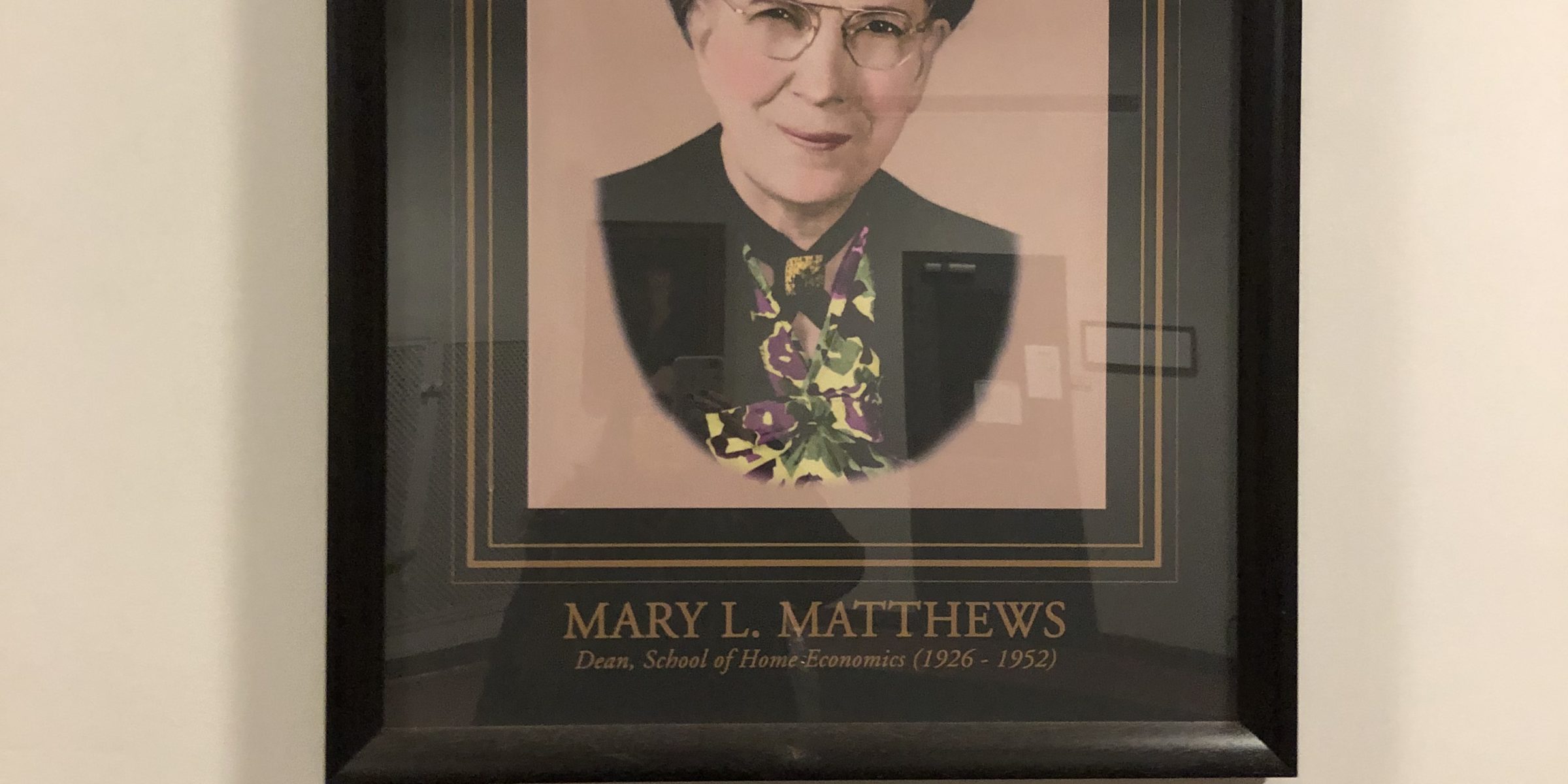
Matthews Hall is home to the school of Health and Human Sciences, what was previously known as Home Economics. Unlike Meredith Hall, this building is completely open to the public so any marking of Mary Matthews should be visible to those who enter. When entering the front doors of Matthews Hall, there is a portrait of her immediately to the right. The portrait is much smaller than the one of Virginia, but it does contain a small biography underneath. Since this portrait is on a wall perpendicular to the entrance, it would not be difficult to overlook. Matthews Hall is more than 47,000 square feet and the only representation of Mary Matthews is a portrait no bigger than twenty square feet.
![Matthews Portrait [3]](https://ascblogs.lib.purdue.edu/fall2019-honors49900/wp-content/uploads/sites/3/2020/01/Matthews-Portrait-3-e1578942257851-225x300.jpg)
![Matthews Plaque [4]](https://ascblogs.lib.purdue.edu/fall2019-honors49900/wp-content/uploads/sites/3/2020/01/Matthews-Plaque-4-e1578942180732-225x300.jpg)
Shreve Hall is a residence hall that houses both men and women. Although her husband tends to be more recognizable, this building is actually named after Eleanor Shreve. I was eager to see how obvious this distinction would physically be made within the hall. On the wall next to the main office hangs a portrait of Eleanor Shreve. This portrait is small, but it does contain information on who Eleanor is. Unlike Meredith Hall, visitors of this building can see the portrait regardless of whether they reside in Shreve Hall. The area in which this painting is located is a popular study area and has constant traffic throughout the day. It is pleasing to see that Eleanor’s portrait has been placed where hundreds of people each day can see.
![Shreve Portrait [5]](https://ascblogs.lib.purdue.edu/fall2019-honors49900/wp-content/uploads/sites/3/2020/01/Shreve-Portrait-5-e1578942294522-225x300.jpg)
![Shreve Plaque [6]](https://ascblogs.lib.purdue.edu/fall2019-honors49900/wp-content/uploads/sites/3/2020/01/Shreve-Plaque-6-e1578942277942-225x300.jpg)
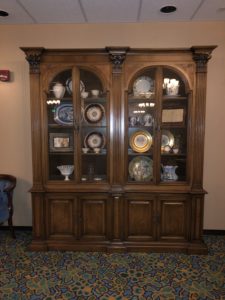
In addition to the portrait, there is a room in the basement named the Jade Room. Eleanor and her husband collected Jade and other stones and carvings. Their collection is currently housed in the Indianapolis Museum of Art, however this room in Shreve Hall is named after this passion of Eleanor. The Jade Room is a large conference style room where meetings and events are often held. Upon entering the room there is a large china cabinet against the wall. Inside this cabinet there is china that belonged to Eleanor and her husband as well as a photo and an article clipping of when the Jade Room was dedicated. This room is a great representation of the work of Eleanor Shreve. Although this was not her professional work, jade was a passion of Eleanor and collecting these stones was a large part of her personal life. The Jade Room is not in plain sight when entering Shreve Hall, however I did not struggle to follow the signs that guided me there. This room is not only used by residents of the hall, but events open to the entire campus are also held in this space. It is important that in Shreve Hall not only is there information on the academic and professional successes of Eleanor Shreve, but also a highlight of what she did in her spare time. This creates a more personal connection between Eleanor and those who use the Jade Room. In addition to china, furniture of the Shreve’s is also present throughout the building. This works as a way to preserve history and keep the presence of Eleanor in a way that students and visitors can benefit from.
A common theme among these three buildings is that hanging a portrait of the space’s namesake is sufficient to honor their work. A portrait is better than no recognition, however when looking at other buildings on campus, more has been done for others. Earhart Hall is located next to Shreve Hall. Earhart contains a dining court and thousands of students each day will enter through the South doors and even more people walk or drive past the building where the statue is still in sight. Outside of these doors there is a large sculpture of Amelia Earhart. Unlike the portraits of Virginia, Mary, and Eleanor, this statue is impossible to miss as it is life size and stands atop a cement platform. Why is it that Earhart hall honors its namesake with a prominent statue on the outside of the building while Meredith, Matthews, and Shreve Hall’s main form of recognition are a portrait. There is something to be said for the medium and value of these two forms of art as a sculpture is three dimensional and is made of a more valuable material while portraits are two dimensional and are created with paint. These differences, which may appear minute, are simply a representation of the larger picture of a lack of recognition for all women that achieved enough to have a building named after them.
Students occupy these three buildings every day of the week and many are probably unaware of the history of it and its namesake. It is important that we honor those who paved the way before us at Purdue. Without these strong women and the pivotal work they did in academia, these spaces for our residence and education would not be here as they are today. More can be done to honor these women and I encourage you to seek out information and be aware of what the name behind buildings truly represents. There is a large margin between buildings on campus named after men and those named after women. The female namesakes of buildings should inspire women of today and the future to achieve something just as great if not greater than the women who came before them.
IMAGES
[1] Malavenda, Zoe, “Portrait of Virginia Meredith,” December 2, 2019
[2] Malavenda, Zoe, “Map of Meredith Hall,” December 2, 2019
[3] Malavenda, Zoe, “Portrait of Mary Matthews,” December 2, 2019
[4] Malavenda, Zoe, “Plaque for Mary Matthews,” December 2, 2019
[5] Malavenda, Zoe, “Portrait of Eleanor Shreve,” December 2, 2019
[6] Malavenda, Zoe, “Plaque for Eleanor Shreve,” December 2, 2019
[7] Malavenda, Zoe, “Eleanor Shreve China Cabinet,” December 2, 2019
Banner Image Reference in bold.