Posted on December 12, 2019 by small20
Mary Matthews
by Zoe Malavenda
Being raised by a strong woman like Virginia Meredith, Mary Matthews learned firsthand how to break barriers and create opportunities for women. After her mother died when she was a toddler, Virginia adopted Mary and her brother. Mary would go everywhere with Virginia including her speeches at universities and agriculture conventions [1]. Mary graduated from the University of Minnesota with a home economics degree, a program that Virginia established seven years prior. Mary originally started working at Purdue in 1910 as an extension home economics instructor but it wasn’t until two years later that she became the head of the Department of Household Economics in the School of Science. In 1926 Mary founded the School of Home Economics and became the first dean of the school. Under the instruction of Mary Matthews, the School of Home Economics at Purdue grew tremendously [1]. What began as a school containing only four courses was now the second largest home economics program in the nation.
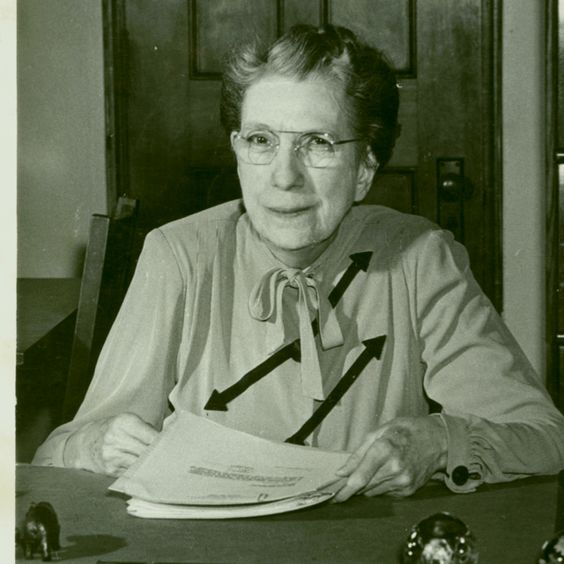
What we would see nowadays as a somewhat problematic and sexist program for women to be enrolled in was actually seen as the opposite at the time. Mary Matthews was very passionate about the work done by women in the home and created the home economics department to benefit these women as they live their lives as homemakers. Before programs like this one existed, many women would just marry and be thrown into the work of a housewife without any prior knowledge of how to run a home. Mary saw the home economics program as an opportunity for women to get an education that would teach them what they needed to know to be a wife and mother. It was said that because of the education women received through home economics, tasks in the home became lighter and easier and life has been made richer fuller and more enjoyable. Not only did a home economics education benefit the wife, but also their husbands and children as these women were educated on what needed to be done to maintain a household and the most efficient way to do so [2]. Today, we may view this type of home economics program as demeaning towards women. It seems as if the only education a woman should obtain was one that would benefit her husband later in life. Although women were receiving a college education in higher numbers, their opportunities were still limited. It is interesting though to realize the thought process of Mary Matthews as she created this school. Mary did not see this as a way to limit the education women could receive, but to bring light to the amount of work women do in the home. Mary was very passionate that the work done in the home should have as much value as the work done by the husband. In creating the school of home economics, she was able to educate people on the amount of work it takes to run a home. Being a housewife was now seen as a career rather than an obligation women had in life. Until Mary Matthews became an educator, work done in the home was overlooked. It was her goal to show people that homemaking is an art and a science not a sort of meaningless work. Without a school of home economics, women were on their own. There were no resources available to ease the stress of learning the ways of running the home. At the time, home economics was an amazing opportunity for women to receive an education to prepare them for their occupation just as a man would for his occupation. Women were given the opportunity to have hands on experiences working in the university nursery as well as the practice house where they would complete tasks like cooking a meal [2]. Just because a woman worked in the home, her work was not any less valuable than the work done by her husband. As Mary Matthews once said, “In families where the housekeeper does the housework herself, this unpaid labor of hers is always equal in money value to the income contributed by those employed outside the home, a fact often not taken into consideration. The husband and wife should therefore consider the maintaining of a home as a partnership business which each should share equally,” [1].
The home economics program was originally created to benefit women, however from 1926 to 1951, the program had ten male graduates [2]. At a glance this seems quite progressive that men would be enrolled in classes about homemaking, but that was not exactly the case. Even in a field dominated by women and created for women, men seemed to have an advantage. For example, both men and women would be studying the work done at restaurants, but the women were being educated on how to work in the restaurant while the men were learning how to manage a restaurant. The few men that went through this program at the time were given opportunities to manage the work of these women when this program was created as an opportunity for women. If women were to be integrated into a male dominated field such as math, it is guaranteed that their work would not be considered as more valuable than a man’s work. Without thinking about it, men in the home economics program could be seen as a good thing but this is not the case when men entered this field and were then taking charge over the women. Men were not taking courses in home economics to learn how to help their wife in the home. They would use this degree to obtain a job outside of the home while a woman with the same education would still be expected to do the homemaking.
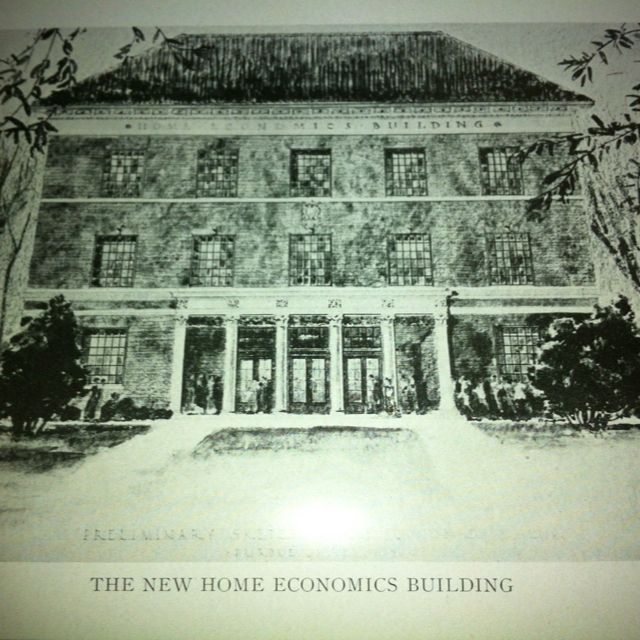
In 1952, Mary Matthews retired from Purdue after being a member of the faculty and administrative staff for 39 years. Before her official retirement in June, the board of trustees had a meeting on April 16 where they confirmed the recommendation of Mary to be made Dean Emeritus of Home Economics. Although she would no longer be serving as dean of the school, Mary was forever recognized for her accomplishments and hard work for the university [2]. Today, the School of Home Economics is called Human Development and Family Studies and resides within the school of health and human sciences [3]. Matthews Hall is home to many classes in the school of health and human sciences. Mary Matthews created a legacy and would be proud to see that more than ninety years later, students are still benefiting from her creations.
[1] “Dean Matthews and Early Progressive.” Purdue News. Accessed December 11, 2019. https://news.uns.purdue.edu/html3month/1997/9705.Matthews.html.
[2] Mary Matthews papers, Archives and Special Collections, Purdue University Libraries https://archives.lib.purdue.edu/repositories/2/resources/944 Accessed December 13, 2019.
[3] “History.” History – Human Development & Family Studies – Purdue University. Purdue University. Accessed December 1, 2019. https://www.purdue.edu/hhs/hdfs/about/history.html.
IMAGES
[4] Matthews Hall. Pinterest. Angie Klink. Accessed December 11, 2019. https://www.pinterest.com/pin/125186064612588111/?lp=true.
[5] Klink, Angie. Mary Matthews. Pinterest. Accessed December 11, 2019. https://www.pinterest.com/pin/125186064612480344/.
Banner Image Reference in bold.